
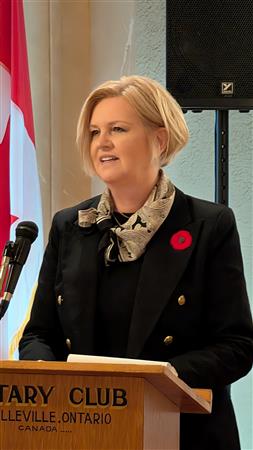
As Remembrance Day approaches, we take a moment to honour the men and women whose courage and sacrifices have helped shape the country we are so fortunate to call home. November 11th is a day dedicated to remembering. Our gratitude for those who have served should extend far beyond this one day. Rotarian Cristina Cadavid was honoured to introduce today's guest speaker, someone who has devoted so much of her life to serving both her country and her community.
Captain (retired) Russell was very pleased to be invited to Rotary today and share a little information about the Canadian Cadet Organizations. Cynthia Russell reached the Compulsory Retirement Age and released from the Canadian Armed Forces four years ago, after serving 10 years as a member of Cadet Instructor Cadre, specifically with 608 Duke of Edinburgh Royal Canadian Air Cadet Squadron here in Belleville. Since the late 1800's the Canadian Cadet Program has offered valuable training to young Canadians free of charge. Army Cadets came first as part of a young militia school program with the mandate of training boys over the age of 12 in military skills and drill. The program thrived with more than 64,000 Cadets enrolled, thousands of whom would go on to volunteer to serve Canada overseas. In 1917 the Navy League of Canada established the Boy's Navy Brigade to encourage young men toward a seafaring career and provide basic training in citizenship and seamanship. In 1941 the Air Cadet League of Canada was officially incorporated as a voluntary organization with the mandate of working in partnership with the Royal Canadian Air Force to sponsor young men as future Air Crew. As far as the 608 squadron in Belleville, during WWII, an Air Cadet squadron was formed and operated in the City. Although no records were retained on this original unit, it did serve to found a legacy to be built upon in the future. In the 1950's Air Cadet Corps and Air Cadet Squadrons were established in various high school locations throughout Hastings County. Squadron 608 (Belleville) was chartered in 1955 and house in Quinte Secondary School. By 1962, 608 began parading out of the Belleville Armouries (and does still to this day). In 1973, Army Navy and Airforce Veterans in Canada, Duke of Edinburgh, Unit 201 petitioned HRH Prince Philip for permission to use the Duke of Edinburgh appellation as part of the squadron name. The Prince granted permission and so it has been since that time, 608 Duke of Edinburgh Royal Canadian Air Cadet Squadron.
There are approximately 53,500 Cadets in cities and towns all across Canada – 8,490 Sea Cadets, 18,920 Army Cadets and 25,890 Air Cadets. There are 235 Sea Cadet Corps, 429 Army Cadet Corps and 453 Air Cadet Squadrons. Girls were admitted to the program in 1975 which means that although Captain Cynthia Russell would grow up to command a squadron, she was not allowed to be a member in her youth. Training for the air cadet program is significant and consists of 5 levels of training where the cadets learn about leadership and citizenship, instructional techniques, conflict resolution, drill and ceremonial, aviation and aerospace, military history, marksmanship, aircrew survival. From a personal perspective as a Squadron leader, Captain Russell remembers the times when cadets exhibited the highest levels of community benevolence and citizenship and showed their community an example of the very best their generation had to offer. They stepped up and made a difference. Captain Russell has been immeasurably proud of these young people. They are committed, dedicated and possess such focus in their pursuit of excellence. They are respectful and aware. These are future leaders! Rotarian Jennifer Savini thanked Captain Cynthia Russell for all the information she shared. Jennifer's nephew is in the air cadet program out West so she is aware of the program's foundation and focus on leadership and citizenship.