
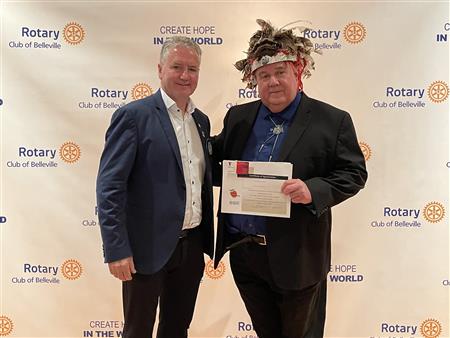
National Day for Truth and Reconciliation is a day for all Canadians to commemorate the history and legacy of the residential school system and Chief R. Donald Maracle came to share some of that history and legacy with the Rotary Club of Belleville at their lunch meeting on Thursday, September 28th. R. Donald Maracle has served as Chief of the Mohawks of the Bay of Quinte for 30 years and for 12 years as Councillor before that. As Chief on the Tyendinaga Mohawk Territory, Maracle has successfully advocated for his community and directed its revitalization as an economically and culturally vibrant nation. Chief Maracle has always been a dedicated, passionate and respectful leader and takes seriously his nation's founding role in the establishment of the great Silver Covenant Chain of Friendship Proclamation of 1763. He is committed to the future of that relationship and to always strengthening and brightening the Chain since, as Haudenosaunee tradition tells us "this relationship will be everlasting. It is for all present and future generations. it shall stand as long as the sun shines upon the earth; as long as the waters flow; and as long as the grass grows green. Our relationship shall be binding, as long as Mother Earth is in motion".
Chief Maracle walked the audience through history when the first trade agreements were reached and the priority was to live in peace and harmony. The lucrative fur trade was the back bone of the Indigenous people, but once tapped out, history shifted and disease and death came, followed by land frauds, rum running, alcohol and the pressure of colonization caused much conflict to the Indigenous people and their land. Residential schools were open and children were taken from their families and institutionalized, unloved and separated from the influence of their families and identity. There were 128 residential schools, housing 150,000 Indigenous people and the children suffered cultural abuse and many died. There was no respect for the original people of our country. Brothers and sisters in the residential schools were not allowed to speak to one another, boys and girls were kept separate. It was a very sad time for Chief Maracle's family as his grandfather was raised in a residential school. The children were not loved and that lack of grounding and nurturing has affected many, many families and will continue to affect generations to come.
Chief Maracle has heard many stories and there is no answer to why this happened. Not only has Chief Maracle had to learn about his aunt's death in the residential school just before her 16th birthday with no records as to where she was buried, a deep personal loss for the family and grief that may never mend. Chief Maracle advocates for making a better future that will take everyone to make a difference and adding a rider to the pages of history. He is hopeful for answers to his questions. It will take more than Orange Shirt Day to make a difference, but it is a small step in the right direction. There is still much poverty in Indigenous communities, no running water, but organizations such as Rotary can be partners to initiate change, real change.